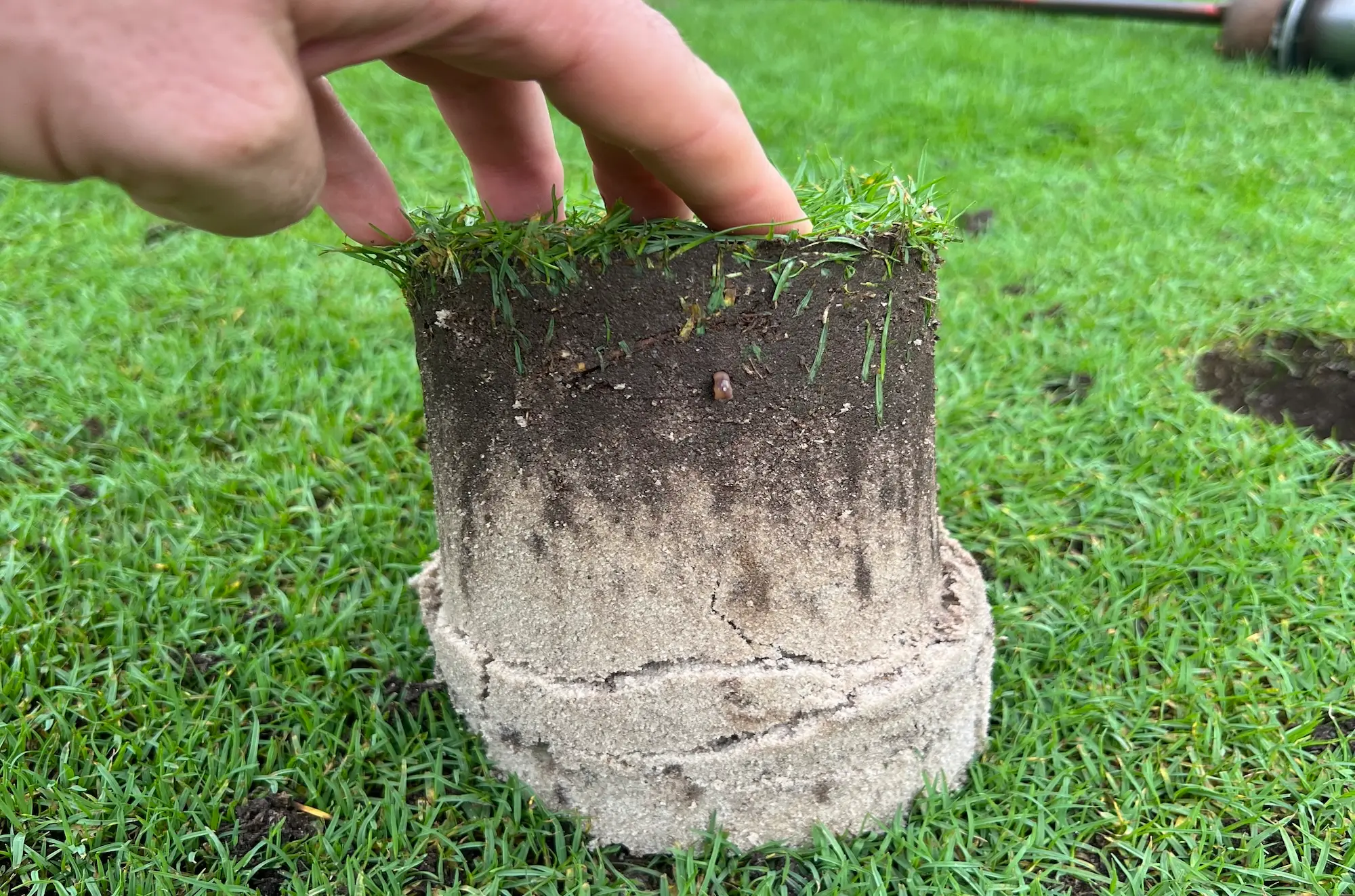
If your goal is simply to provide nitrogen to a healthy, actively growing turfgrass plant, then the nitrogen source is often far less important than many people think. However, there are situations where the form of nitrogen can influence nutrient efficiency, environmental losses, turf response and even pesticide performance.
To understand why, it is important to understand what actually happens to nitrogen after it is applied.
However, high ammonium ratios can also influence soil chemistry. As ammonium is converted to nitrate it contributes to soil acidification, which may be beneficial on alkaline soils but less desirable where soil pH is already low.
For this reason, most turfgrass systems tend to perform best when ammonium represents part of the nitrogen program rather than the entire program.
The Three Forms of Nitrogen
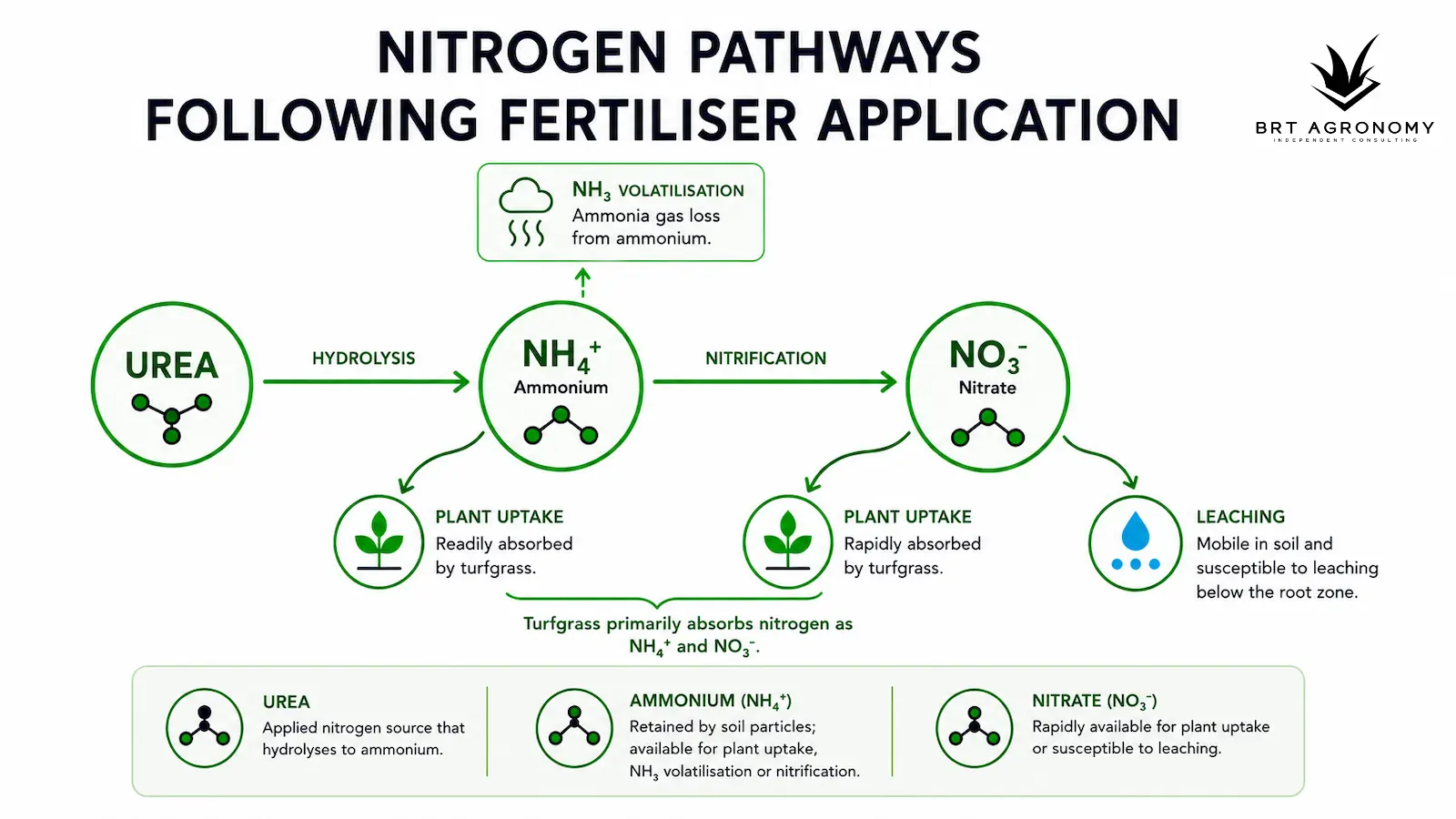
Most fertilisers contain nitrogen in one of three forms:
- Urea (CO(NH₂)₂)
- Ammonium (NH₄⁺)
- Nitrate (NO₃⁻)
Whilst fertiliser labels may list multiple nitrogen forms, almost all nitrogen eventually ends up as either ammonium or nitrate in the soil.
Urea is converted into ammonium through the action of urease enzymes. Ammonium is then converted into nitrate through nitrification.
In other words, regardless of what nitrogen source we apply, the turf plant will eventually be dealing with either ammonium, nitrate or a combination of both.
This is one of the reasons why many research studies have found relatively small differences in turf performance between nitrogen sources when total nitrogen application rates are equal.
Urea - The Workhorse of Turf Nutrition
Urea contains approximately 46% nitrogen, making it the most concentrated and commonly used nitrogen fertiliser in turf management.
It is inexpensive, highly soluble and works exceptionally well in foliar spray programs.
Research has shown that a significant proportion of foliar-applied urea can be absorbed within just a few hours of application. This helps explain why spoon-feeding programs using low rates of urea have become so popular on golf course putting greens.
For most turf managers, urea forms the backbone of their fertility program.
However, urea does have one significant weakness.
Volatilisation.
When urea remains on the surface, particularly under warm temperatures, high pH conditions or where irrigation and rainfall are delayed, some of the nitrogen can be lost as ammonia gas before it ever reaches the plant.
This is why managing the period immediately following a urea application is often more important than the fertiliser source itself. Whether applied as a granular or foliar treatment, irrigation, rainfall and environmental conditions can all influence the amount of nitrogen ultimately available to the plant.
Ammonium - More Than Just Nitrogen
Ammonium is often viewed as a readily available nitrogen source that is less susceptible to leaching than nitrate.
Because ammonium carries a positive charge, it can be retained by negatively charged soil particles rather than moving freely through the profile.
This can be advantageous in sandy soils and USGA greens where nitrate movement is often a concern.
Ammonium can also play an important role in pesticide performance. Ammonium sulphate is commonly used with certain herbicides to improve uptake and reduce cation antagonism from hard water. In these situations, the nitrogen source is doing far more than simply feeding the turf.
Nitrate - Fast Response When You Need It
The plant can absorb nitrate directly and turf response is often rapid. This can be particularly useful when turf requires a quick recovery boost following stress, tournament preparation or before a period of heavy traffic. Whilst nitrate may not be the most economical source of nitrogen, there are situations where a rapid response is more important than cost efficiency.
Research has shown that nitrogen form can influence growth patterns within the plant. In a greenhouse study on Penncross creeping bentgrass, nitrate produced the greatest shoot dry matter, whilst urea produced the greatest root and total plant biomass. Whilst field conditions are far more complex than a controlled nutrient solution study, the findings support the practical observation that nitrate often provides a rapid visual response.
The downside is that nitrate carries a negative charge.
Because soil particles are also negatively charged, nitrate is not retained in the soil profile and can move freely with water.
This is why nitrate is generally considered the most leachable form of nitrogen.
Research on intensively managed turfgrass systems has consistently shown that nitrogen leaching losses are often much lower than many people expect, particularly when applications are matched to turf growth requirements.
Turfgrass is actually very efficient at recovering applied nitrogen.

So Which Form Does Turf Prefer?
This is where things become less exciting than many fertiliser marketing campaigns would have you believe.
The reality is that turfgrass performs extremely well with urea, ammonium and nitrate. There is evidence that nitrogen form can influence both growth patterns and nutrient uptake within the plant. In the same creeping bentgrass study, urea resulted in higher phosphorus, calcium and magnesium concentrations compared with ammonium treatments, whilst nitrate increased the concentration of several micronutrients.
These findings may partly explain why turf managers occasionally observe different turf responses despite applying similar amounts of nitrogen. However, the practical significance of these differences is often much smaller than the effects of total nitrogen input, application timing, environmental conditions and irrigation management.
Most research suggests that application timing, annual nitrogen inputs, clipping yield, environmental conditions and irrigation management have a much greater influence on turf performance than the specific nitrogen form being applied.
In many cases, the question should not be:
"Which nitrogen source is best?"
It should be:
"Am I applying the right amount of nitrogen at the right time?"
Nitrogen Source vs Nitrogen Requirement
In my experience, many turf managers spend considerable time evaluating different fertiliser products, technologies and marketing claims. Liquid fertilisers, controlled-release products, enhanced efficiency fertilisers and speciality formulations are often promoted as offering unique advantages over more traditional nitrogen sources.
However, relatively few discussions focus on how much nitrogen the turf actually requires annually.
Understanding nitrogen requirement is usually far more important than selecting a specific nitrogen source or new fertiliser technology.
A perfectly selected nitrogen source applied at the wrong rate is still the wrong approach.
Unfortunately, the fertiliser industry has traditionally done a far better job marketing products than helping turf managers understand actual plant requirements.
This reminds me of one of my favourite USGA articles, "Does the Grass Know the Cost of Fertiliser?"
The article challenges the assumption that more expensive products automatically produce better turf. The reality is that the plant has no idea what was paid for the fertiliser. It simply responds to the nutrients that are available and the environmental conditions surrounding it.
The same principle applies to nitrogen sources.
Before worrying about whether nitrogen should come from urea, ammonium sulphate or a nitrate-based fertiliser, it is worth first understanding how much nitrogen the turf actually requires.
This is one of the most common areas we review during consulting visits. Turf nutrition programs are often built around product availability, supplier recommendations, or historical practices rather than actual turf requirements, clipping production, and performance goals.
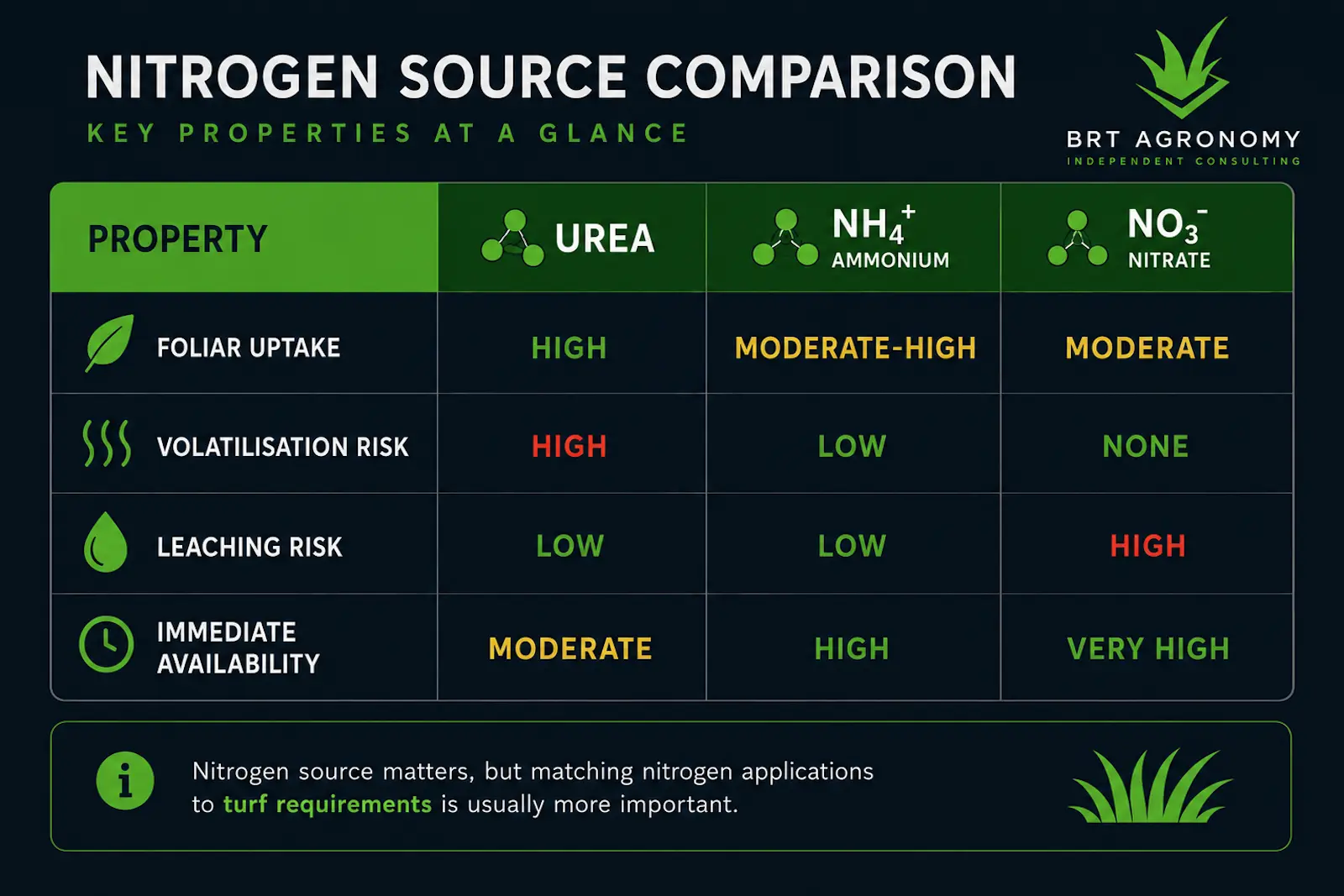
When I Actually Care About Nitrogen Source
Whilst I generally place more emphasis on total nitrogen inputs and timing, there are situations where nitrogen form becomes important.
Volatilisation Risk
If a granular
application is going to sit on the surface for long periods of
time without irrigation or rainfall, I become more conscious of
urea losses.
Similarly, whilst urea remains my preferred foliar nitrogen source in most situations, there are times when ammonium or nitrate sources can be useful. If volatilisation is a concern or irrigation timing is uncertain, these forms avoid the hydrolysis and ammonia loss pathway associated with urea.
Leaching Risk
On sand-based greens,
particularly where irrigation volumes are high, excessive
nitrate applications may increase the risk of nitrogen movement
through the profile.
The actual risk depends heavily on soil texture, irrigation practices and environmental conditions, which is one reason soil and water testing remains such an important part of building an efficient turfgrass nutrition program.
Growth Management
Different nitrogen forms
can influence growth response, colour and turf behaviour. While
these effects are often smaller than many people expect, they
can still influence product selection.
Pesticide Compatibility
This is probably
the area where I pay the most attention to nitrogen source.
Over the years, I have observed increased turf injury where urea has been applied with, or in close proximity to, certain herbicide applications.
While the exact response will depend on environmental conditions, turf species and application rates, increasing nitrogen uptake can also increase herbicide uptake. In this situation, more uptake is not necessarily a good thing.
Conversely, ammonium sulphate is often deliberately included in spray programs because it can improve the performance of certain herbicides.
This is a time when understanding the chemistry of the pesticide is often more important than understanding the chemistry of the fertiliser.
The nitrogen source is not simply feeding the plant. It may also be influencing how the pesticide behaves.
Final Thoughts
For most situations, the question is not whether nitrogen should come from urea, ammonium or nitrate.
The more important questions are:
- How much nitrogen does the turf actually require?
- When should it be applied?
- How can losses be minimised?
Once those questions have been answered, the nitrogen source becomes much easier to select.
The research consistently shows that healthy turf can be produced with urea, ammonium and nitrate.
So, do I care about the nitrogen source?
Yes.
But probably not for the reasons most people think.